Primarily the charm of titular Georgia
propels the reader through the book. She
is at once bold and lady-like, selfish and touchingly full of care for her
disintegrating family. But part of what
Childress so skillfully pulls off is a kind of effortless narrative style that
picks up Georgia ’s
own voice. It isn’t exactly free
indirect discourse, but it does have an intimate quality that puts you
immediately on Georgia’s side, in Georgia’s head, and almost makes you feel as
if you were chatting with her while lounging on a great Southern porch. Here’s a perfect example from page one:
Tuesday, June 12, 2012
Guilty Pleasure Without the Guilt: Reflections on Mark Childress's Georgia Bottoms
Thursday, June 7, 2012
Dude: Reflections on Ron Carlson's Five Skies
“In Chick Lit,” writes Laura
Fraser, “women write about their emotions. In Dude Lit, men use rock ‘n’ roll
songs as a stand-in for their feelings. The more complex the emotions, the more
obscure the band.”
I know, I know, I get sick of
beating the gender drum too. But Ron
Carlson’s Five Skies has such a male
quality to it that I can’t help but begin with gender. And as you’ll see by the time I finish, it’s
clear that he’s doing an interesting blend of “dude lit” and “chick lit” that
ends up blurring labels the way all good books do.
Ron Carlson’s Five Skies does not follow the dude lit
mold Fraser describes above. Instead of
using rock songs as emotional stand-ins, Carlson has created a book that
recognizes how difficult it is for men to deal with emotions, even though the
emotions are present and the men have a very real desire to deal with them. The book operates on premise more than plot:
three men work on a construction project in Idaho . They do not
previously know one another, but the two leads, Arthur Key and Darwin, are both
freshly grieving personal tragedies. The
third man—who, at twenty, is just breaking into manhood—is troubled by his own
ignominious history. For me, the book
was strongest
Tuesday, June 5, 2012
Squaw Valley or Bust
A few weeks ago, I received some good news: I’ve been
accepted to the Squaw Valley Community of Writers and will be attending the
fiction workshop in July. I can’t
wait! Writers and conversation on the
northern shore of Lake
Tahoe , where I have never been—what could be
better?
| Me outside the old Borders store in Ann Arbor-- a tribute to yesterday's method of finding books. |
I’ll tell you: prep reading.
I treated myself to an afternoon at the library yesterday, trolling the
shelves for books by Squaw Valley faculty and finding a
stack so large it left red marks on my wrists even after I got home. I knew that Squaw Valley
faculty were worth their salt from my copyediting (three times!) the book WritersWorkshop in a Book, edited by Alan Cheuse and Lisa Alvarez. The essays—all of them by Squaw
Valley faculty—range from trying to start a novel that isn’t ready
to be started (Lynn Freed’s essay) to knowing when a novel is done (Mark
Childress). There are essays on writing
that appeals to the senses (Janet Fitch) and on details that bring the writing
to life (Joanne Meschery). It’s a great
book on craft, varied and accessible and saturated with wisdom earned through
experience. But before I go to the
workshop and get firsthand exposure to such advice, I want to take a look at
the faculty not as craft advisors but as practitioners of their own art.
So, from now until I leave for Squaw Valley
in July, I plan to read as much as I can of the faculty I hope to meet. This reading can’t be comprehensive—too many
books, too little time—so be aware that my personal bias towards novels has
already made me pass over some (no doubt) very fine nonfiction. What I end up reading will be some
combination of synopses that hooked me and the fate of which books fall into my hands.
First up is Ron Carlson’s Five Skies, which I read last week, followed
by Mark Childress’s Georgia Bottoms, which I’m part way through. Stay tuned to the blog for thoughts on each,
and I hope you’ll keep reading as I report on my experience with the Squaw
Valley Community of Writers. It just
might lead you to some great summer reading of your own.
Monday, January 23, 2012
Happy Birthday To...
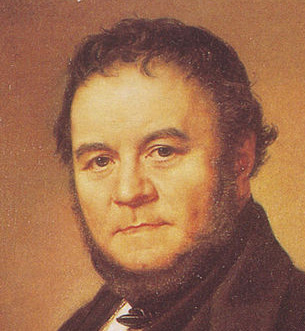
Because of Stendhal and the debt I owe to his ideas and works, January 23 is fixed as firmly in my mind as if he were a sibling or parent. And since the day is already flagged, I've tacked on another note of personal significance: it is the birthday, too, of Alan Cheuse, the writing teacher who has most directly influenced me.
With these concordances, it would be impossible not to reflect on the way literature unites disparate people from disparate times. In a way, I know both 229 year-old Stendhal and the so-young-by-comparison Alan Cheuse. Stendhal is unique in how strongly his personality leaps from the page in any of his nonfiction works; after reading him, it's difficult not to feel like you know him. Of course, a writer's fingerprint always lingers in his works, but rarely have I encountered a personality as unmistakable as Stendhal's--by turns certain and insecure, visionary and mundane. When I read works by Alan Cheuse, whom I know personally, I have the opposite pleasure of finding in a sentence or an idea something that seems to me unmistakably Alan, something I can practically hear him saying in my mind's ear.
Because I will be wandering around the annual U.S. Army Band Tuba and Euphonium Workshop later this week, tubas are also on my mind today. I have noticed that most, if not all, serious tuba players are happy to tell you their tuba lineage, tracing their teacher and their teacher's teacher back to a great tuba father like William Bell or Harvey Phillips. In the same way, I have fun knowing that Alan Cheuse's teacher was John Ciardi, and whenever I read a Ciardi poem, I feel proud of my "family tie." Still, as with any reader, the greatest ties a writer can have are with the writers we will never meet, nor even can--the ones whose ideas or style or subject speak directly to us, nevermind that they have been dead some years or decades or centuries and are a nationality not our own. So, if you're reading this, I invite you to post a comment telling which writer or writers you trace in your lineage, whether real or felt.
Sunday, November 13, 2011
In Memoriam Dr. Donald Busarow
Today I had the great honor of sharing some words at the memorial service for a beloved mentor, teacher, friend, and musician, Dr. Busarow of Wittenberg University--or, as we knew him, Dr. B. I have already received requests for a copy of my talk, so in the interest of sharing it with those of you who were a part of these choir experiences--and, of just as much importance, with those who weren't--I am posting here to my blog. First, though, I would like to thank Pastor Rachel Tune, Bob White, and the Busarow family for giving me the opportunity to participate in this way. And I would also like to take a moment to thank Dr. B, who even in death is providing me a sense of guidance. During the memorial service, I was struck with the impression that, in his life, Dr. B did what he was made to do. He didn't shy from the task of passing his light on to others, but did it with dedication and energy for years and years. This past Tuesday, I received word from my agent of two more publishing houses that had rejected my first novel manuscript. That same day, my phone rang, and it was Pastor Rachel asking me to prepare something for the memorial because, in her words, I am a writer. What a great and timely reminder that when you feel you have something to offer--in my case, my writing--you must pursue it, no matter how difficult and demanding the journey might be.
So without further ado, I hope you will click on "Read More" to see my thoughts about the Wittenberg Choir experience under Dr. B as I lived it from 2002 to 2006.
Friday, November 11, 2011
Domestic Novel? Reflections on Arlington Park
This past week, I read Arlington Park, a novel by Rachel Cusk. Cusk is obviously a talented writer, and her resume shows it: a Whitbread award and a shortlisting for Whitbread, the shortlist for the Orange Prize, and a citation from Granta as one of Britain's 20 best young writers. While blurbs on book covers rarely reflect what's on the pages therein, in Arlington Park's case, the promised "incisive" quality that book reviewers heralded turned out to be true. Unfortunately, despite all this, I just couldn't agree with the ends to which Cusk put her talent.Arlington Park follows six women trapped in privileged suburban life. The question of how to find fulfillment in suburban life crops up frequently in fiction, not the least in my own first novel. But the difference between the perspectives of Cusk's women and of women in, say, Allegra Goodman's Kaaterskill Falls, is vast.
Thursday, November 3, 2011
And We're Back!
Well, that was certainly a longer hiatus than I anticipated, but while this blog was languishing, yours truly was relocating from Fairfax, Virginia, back to my native Ohio. Husband Nat and I found a charming apartment in an old house, and we are at last happily settled in. Or I should say, settled in enough that I can resume my daily habits of reading and writing.But not all that space from July to now was void of literary pleasures. In September, I had the great privilege of escorting Allegra Goodman around Fairfax. Not only did she give a wonderful reading with Alan Cheuse, but she also proved to be as generous and kind in person as you might deduce from her books. In preparation for her visit, I read Kaaterskill Falls, a finalist for the 1998 National Book Award, and found that I appreciated it more than her recent Cookbook Collector. She read, however, from The Cookbook Collector, and the passage she delivered made me think again about the good amount of wit and observation behind that book. (For more of my thoughts on Cookbook Collector and Goodman’s fiction, see my post of April 5.)
Another highlight for me was reading Alan Bennett’s novella The Uncommon Reader in the midst of my moving mayhem, a perfect break from boxes and bubble wrap. Talk about witty: the premise is that the queen of England discovers a love of reading, and Bennett doesn’t miss an opportunity to satirize society’s attitude towards books, nor to reveal the transformative power of reading. Never have I seen the reasons for reading so clearly and so un-sentimentally presented. The novella itself is just the right length: it tells its story economically, uncluttered by side characters or subplots—in short, it is a true novella, well-executed and deliciously fun to read for those who love to read anyway. It’s a little like the recent movie Midnight in Paris in that catching allusions and references is more than half the fun of the book. But for those who don’t love to read (how mysterious you wound up at my blog!), this novella is imperative—it just might inspire you to visit a local library.
Finally, I have been at work on drafting my second novel, albeit with interruptions. Since I’ve been writing this one by hand (a topic for another post—stay tuned!), I decided my first real day of writing here in my new place—yesterday—should be a survey of what I have so far. I typed up the pages I hadn’t yet typed and found to my happy surprise that I have 77 pages. True, they’re not all brilliant; true, writing is ultimately about quality, not quantity; but my approach to writing is to first cough up the stone and worry about sculpting it later. Yesterday was a blue-eyed, sun-kissed day, so I took my little manuscript to Schiller Park, and there, in the presence of the great German poet himself (okay, okay, just his statue), I read it. The verdict? Hey, it’s a first draft.
Subscribe to:
Posts (Atom)